


What do you think of when someone asks you to describe a working farm?
You probably think of green pastures, cows grazing, plenty of sunshine, chickens laying eggs or horses running free in the field.
But is that really a true depiction of today’s 21st century working farm?
The advancement of technology is two-fold: on one hand it is great as it can make our daily lives easier; once was a world when you had to pay for a long-distance phone call, but now, with the click of an app, you can video chat with anyone in the world. Modern technology has allowed us to explore the galaxy, the oceans and the atmosphere.
And on the other hand, people consumed with greed and evil, have taken our modern technology and turned it into something that lines their pockets and kills the general population at the same time.
Before I go any further, I encourage you to watch the documentary, “Food, Inc.” which was produced in 2008 and, per Wikipedia:
“It examines corporate farming in the United States, concluding that agribusiness produces food that is unhealthy in a way that is environmentally harmful and abusive of both animals and employees. The film received positive reviews and was nominated for several awards, including the Academy Award for Best Documentary Feature and the Independent Spirit Award for Best Documentary Feature.”
Now 2008 was 16 years ago, so I would assume a LOT has changed (and not for the better, of course) since then. But the documentary is fascinating and quite an eye-opener, so please be sure to watch it!
For this post, I will be focusing on the use of growth hormones in our meats and how they not only affect the animals that are injected by them, but how they also affect the people that consume those injected meats.
Here are some interesting statistics from The Market Works regarding the meat industry:
- the U.S. meat industry directly employs more than 500,000 people
- the U.S. has 835 federally inspected livestock slaughter plants and 370 poultry slaughter plants
- annual sales total $152.5 billion in meat packing and processing and $65.6 billion in poultry slaughter and processing
- in 2019, the industry exported 3.02 billion pounds of beef and 6.3 billion pounds of pork to nations around the world. Poultry companies exported 7.2 billion pounds of chicken products and nearly 640 million pounds of turkey
According to Statistica:
“The value of the global meat sector was estimated to value at 897 billion U.S. dollars in 2021, and was forecast to increase to 1354 billion U.S. dollars by 2027.”
An interesting note is that the U.S. is the biggest consumer of meat when compared to other countries around the world.
Now, don’t get me wrong….I love to eat meat; it is high in protein, full of vitamins, keeps me full longer and tastes great! Even God Himself, after the great Flood, told Noah and his family that they were allowed to eat meat.
But I have learned a long time ago is that it is not only pure meat I am eating, but a whole host of other “stuff” that isn’t pure at all.
Growth hormones are injected into meat-producing animals to:
- improve growth rate
- better feed conversion efficiency
- better carcass quality
In other words, these hormones cause the animals to mature faster so that they go to slaughter faster; thus, causing more profit to come in at quicker rates.
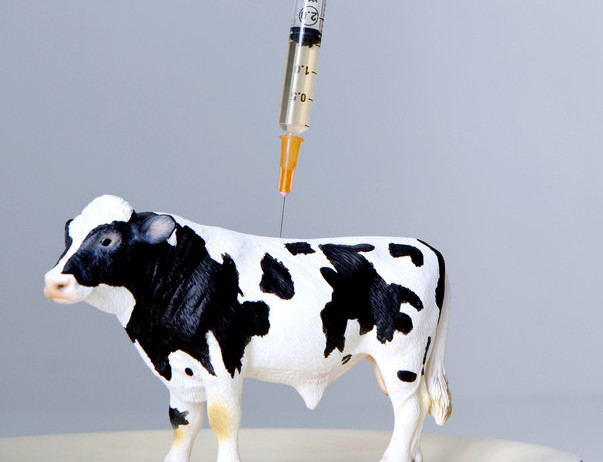
And injecting growth hormones into animals does NOT in any way involve gloves, a syringe, liquid in a vial or a jab to the hide of the animal.
In fact, it is quite bizarre…..
According to BusinessInsider.com:
“Instead of a liquid injection with a syringe, many farmers drive a steroid-loaded pellet or “implant” between the skin and cartilage of the back of the animal’s ear. The guns used to inject the pellets resemble a larger version of an ear-piercing gun for humans. And like an ear piercing, it’s typically a once-and-done affair. Over time, the medication slowly releases into the animal’s bloodstream. (The ear is sliced off during slaughter and discarded to prevent implants from entering the food supply.) When farmers give their livestock such growth-promoting drugs — which can include natural and synthetic versions of estrogen, progesterone, and testosterone — the cow’s weight increases rapidly. These drugs boost production of growth-stimulating hormones that help the animal convert feed into muscle, fat, and other tissues more efficiently than they would naturally. This artificial plumping process boosts the amount of meat that farmers can sell per animal, putting more money into their pockets.”
Sounds pretty disturbing, right?
So what type of hormones are used on our livestock?
- Estradiol – used to promote weight gain in animals; linked to cancer
- Progesterone – used to promote growth in animals; linked to cancer, hormonal issues, reproductive issues and developmental issues
- Estrogen – used to promote growth; linked to cancer especially breast
- Testosterone – used to gain muscle and promote growth in animals; linked to impaired growth, disrupted fertility and cancer
- Zeronal – banned in Europe, it is used for the growth promotion of sheep and cattle; linked to breast cancer, reproductive issues and liver and pituitary tumors
- Trenbolone Acetate – promotes muscle growth in cattle; linked to cardiovascular issues, high blood pressure, and extreme instances of violence
Estrogen and Testosterone are present in both male and female humans, but in consuming additional residues of Estrogen and Testosterone from meat consumption, no wonder we have medical disorders of where men and women can experience higher levels of either that produce side effects including:
- cardiovascular issues
- digestive issues
- hair loss
- weight gain
- insomnia
- mood disorders
- muscle/joint pain
- vaginal discharge
For women, there is a case called High Estrogen, where there is too much estrogen in the body. For men, there is a cased called High Testosterone where there is too much testosterone in the body. Both instances are red flags in the medical field and are usually treated with medications.
High Estrogen is treated with aromatase inhibitors, gonadotropin-releasing hormone (GnRH) agonists, and synthetic luteinizing hormone-releasing hormone (LHRH).
High Testosterone is treated with glucocorticosteroids, oral contraceptives, metformin, and eflornithine.
Of course, with these “treatments” being all pharmaceuticals, they will have side effects and may cause other medical issues, and if you have read my previous blog posts, the value of most pharmaceuticals, in my opinion, is equal to the value of swiss cheese!
Growth hormones not only affect humans, but the animals themselves.
In 2013, Reuters conducted an investigation and found that 15 cattle were given a growth stimulant called “Zilmax”. This caused the cattle to appear mangled and barely able to walk as they were walking to the slaughterhouse at a Tyson Foods facility.
Tyson Foods claimed they didn’t know what happened to the cattle, and vowed to never use Zilmax (produced by pharmaceutical giant Merck) again.
Later, Merck pulled Zilmax from the shelves of the U.S and Canadian markets following other reports of cattle deformities, but yet still stated (insisted), ” Zilmax is safe when used according to the product label and in conjunction with sound animal husbandry practices.”
Undercover investigator, Joe Fassler, wrote his findings on how the beef industry deliberately quashes any negative press or negative marketing to protect their bottom line.
The Masters of Beef Advocacy is a program created by National Cattlemen’s Beef Association and it teaches how to engage consumers with friendly talking points reminding consumers about the role of beef in a healthy diet and how farmers raise beef sustainably. Basically, they try to alter the narrative and cherry-pick information to support their advocacy despite many instances of leaked photos and videos stating otherwise.
Per Yahoo:
“In 2006, the UN Food and Agriculture Organization published Livestock’s Long Shadow, a report that outlined animal agriculture’s significant contribution to creating planet-warming gases, putting the meat industry firmly in the spotlight. The beef industry has mounted a counteroffensive, attempting to kill the negative press with blog posts, videos, ads, social media campaigns, and trained influencers.”
The Humane Society of the United States is conducting investigations into the treatment of animals raised to slaughter; treatments that include:
- confining animals to small cages
- animal mutilations
- unsanitary conditions
- genetic manipulation
Because of organizations like the Humane Society, meat recalls, slaughterhouse shutdowns, criminal convictions and improved federal policies have developed.
However, some states in our very own United States, have passed laws to silence/criminalize whistleblowers (also known as ag-gag law):
- in Utah and Idaho, it is a crime to take photos of an animal being abused in a slaughter plant
- in Kansas, passed the first ag-gag law in the US stating trespassing on a livestock facility to take photos/videos is subject to criminalization
- in Iowa, if any agricultural business owner finds that an applicant for a job lied about being a member of an animal-welfare charity, that business owner can prosecute the applicant resulting in a hefty fine or jail time
- in Alabama, passed in 2002, this law makes it illegal to enter agricultural premises under false pretenses and criminalize any possession of that premise’s conditions/state of order
- in Montana, law makes it illegal to to take photographs and/or video without consent of the owner
- in Arkansas, law allows agricultural businesses to sue whistleblowers who expose unsanitary conditions and animal abuse
Many members of the media and animal-advocates attempt to take these states to court deeming them as unconstitutional.
And if animals are not only injected with hormones that are indeed consumed by humans, what else are we ingesting if animals are treated so cruelly on these “farms”? What happens to the quality of the meat??
Paul Shapiro, vice president of farm-animal protection at the Humane Society of the United States, told the National Review:
“You know that an industry has a lot to hide when it wants to make it a crime to document what it’s doing. The proper response from lawmakers to the pervasive cruelty endured by farm animals isn’t to crack down on the whistleblowers. Rather, lawmakers should crack down on that cruelty by requiring better treatment of farm animals. Considering how much we take from them, a modest amount of basic decency is the very least we owe these animals.”
Take a look at the photo below:

The one on the left is organic, grass-fed beef and the one on the right is the “processed” beef. Quite the difference, huh?
Professor Olugbenga Ogunmoyela, President of the Consumer Advocacy for Food Safety and Nutrition Initiative, said:
“Consumers generally prefer to purchase raw meat that is brightly red-coloured because to them it is of good quality and fresh. This is the origin of the practice of adding chemicals such as sodium nitrate and carbon monoxide by processors and sellers. These chemicals prevent a chemical reaction known as oxidative browning, which is the primary basis for rejection of fresh beef in retail displays by consumers. The oxidation process spoils most foods, especially those with a high fat content such as meat. Fats quickly turn rancid when exposed to oxygen. However, high consumption of meat and processed meat products has been suggested to have detrimental effects on human health and the increase in cancer has been attributed to these chemicals. There are limits prescribed for some food additives in the codex standard, which are not supposed to exceed the amount needed to accomplish the purpose for which the additive is required in that food. However, the addition of unquantified measures of these chemicals to food is against food safety standards and regulations. Overall, opting for fresh, whole foods is strongly recommended as an essential step in making informed and healthy choices about the products we consume.”
In order to protect yourself and your family, be sure to purchase organic, grass-fed meat and don’t be fooled if the label says “natural”. The better quality of meat may be more expensive, but it will benefit you health-wise in the long run. Use these graphics to help you next time you are shopping in the meat aisle at your local market:


If you would like to learn more about ag-gag laws and find ways you can voice your opinion, please visit the Animal Legal Defense Fund here.
The American public deserves to know what is in their food. It is a basic, human right and it is my hope, that with more and more people opening their eyes and taking more caution when shopping for groceries, that we can change this industry….one burger at a time!




Leave a Reply